Why foldable phones still feel like a work in progress
I have handled several and I have not bought one. That is not a verdict on the category, it is a statement about where it currently sits, and I want to be specific about why rather than gesturing at durability.
The crease
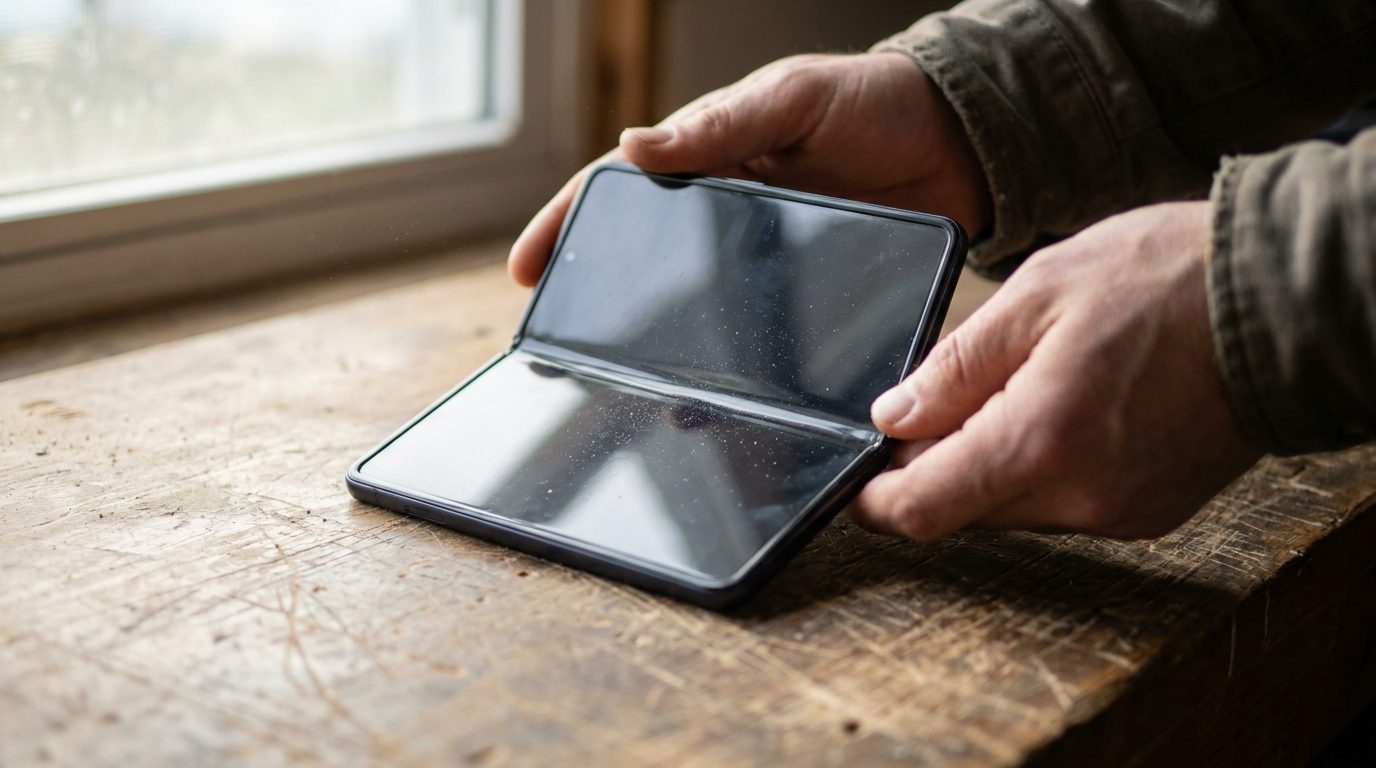
There is a crease. Manufacturers have reduced it considerably and it is still there, visible at an angle and detectable under a finger.
You stop noticing it within a week, genuinely. But it is the honest first thing to mention because every review that skips it is managing you.
The screen material
The inner display cannot be glass in the way a normal phone's is, because glass at that thickness does not fold repeatedly. It is a plastic or ultra thin glass laminate with a protective layer on top.
That layer is softer than the glass you are used to. It marks more easily. A fingernail can leave a line. Grit trapped in the fold is a real hazard.
And the protective layer is not user removable on most models, which people discover by peeling it off and destroying the screen. That still happens.
The hinge
Hinges have improved enormously and they are now genuinely well engineered pieces of hardware.
They are also the part with the highest consequence of failure, they are expensive to replace, and the ingress of dust is an ongoing design challenge. Water resistance ratings on foldables have improved and dust resistance remains the harder problem, because a hinge has to have gaps.
If you work somewhere dusty, this is a real consideration rather than a theoretical one.
Repair cost
An inner display replacement is expensive, frequently a substantial fraction of the price of the phone.
That changes the insurance calculation entirely. For a conventional phone I am relaxed about skipping a protection plan. For a foldable I would think much harder, and that additional cost belongs in the purchase decision.
Software
Applications have to handle two very different screen sizes and a transition between them, and many still do not do it well.
You unfold the phone and an app restarts, or stretches an interface designed for a narrow screen across a square one with enormous margins. The major applications are mostly fine now. The long tail is not.
Weight and thickness
Folded, these are thicker and heavier than a conventional phone. That is unavoidable, since there are two halves.
The book style foldables are noticeably heavy in a pocket. The flip style ones solve that and give you a smaller device at the cost of a smaller outer screen.
What they are genuinely good at
Reading. A larger screen for documents, articles and email is a real improvement and the people I know who love theirs mostly love it for this.
Multitasking, two apps side by side properly rather than cramped.
The flip form factor for anyone who wants a smaller phone in a pocket, which is a preference the industry otherwise stopped serving years ago.
Video, obviously.
Who should buy one now
Someone who reads a lot on their phone and will actually use the larger screen daily.
Someone who wants the smaller folded size of a flip and knows they will live with the compromises.
Someone who enjoys new hardware and can absorb a repair bill.
Who should wait
Anyone buying primarily on the basis that it looks impressive.
Anyone who keeps a phone for five years, because the long term durability record on these is still short compared with conventional phones.
Anyone who works in a dusty environment.
My actual position
The engineering is genuinely impressive and the trajectory is good. Each generation has been better than the last in ways you can feel.
I am waiting for the inner screen to survive a fingernail and for repair costs to come down. When both of those happen I will buy one, and I suspect that is closer than it was two years ago.