The real reason cheap replacement chargers keep breaking
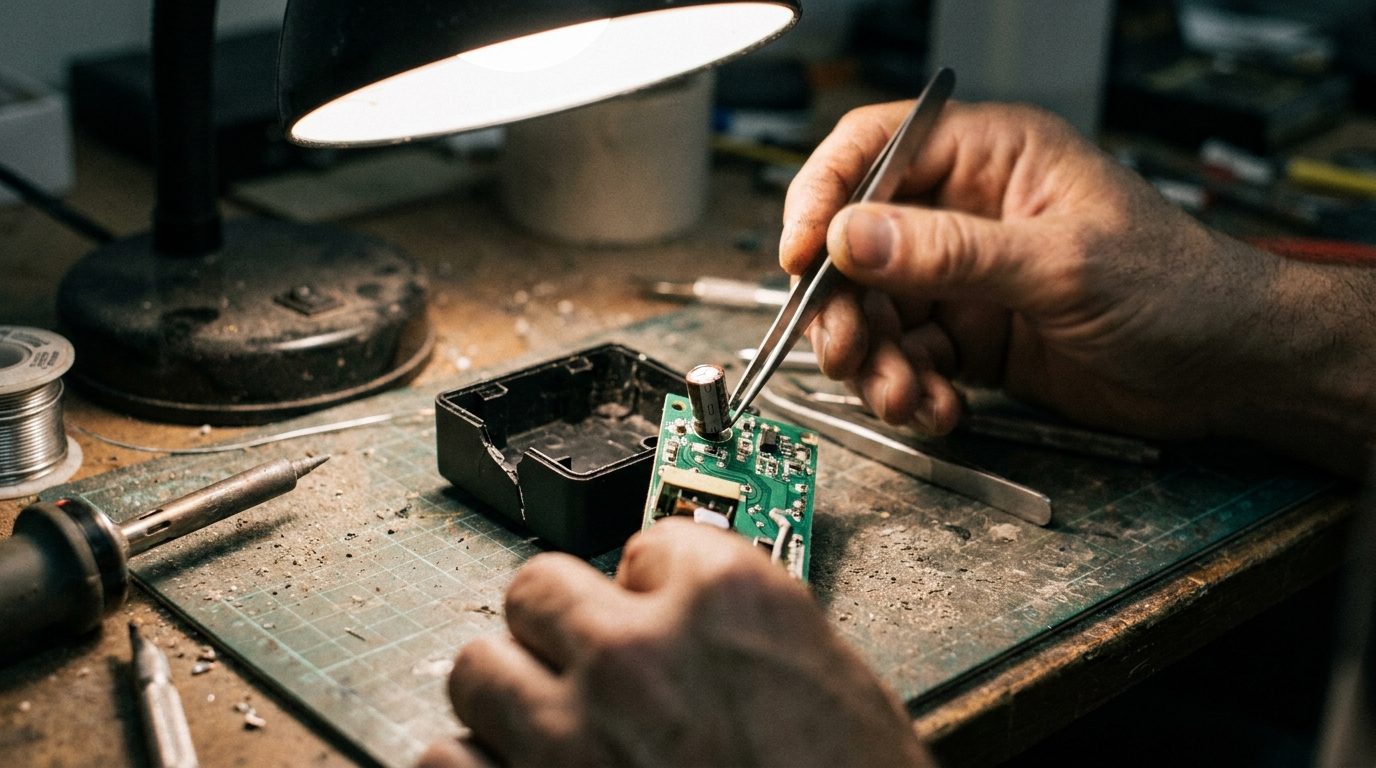
I keep a drawer of dead chargers. Not for sentiment. Because when someone asks why the cheap one failed again, it is easier to open one up than to explain.
Inside a good charger and inside a very cheap one you are looking at the same basic circuit doing the same job, and the difference is entirely in the components chosen and what has been left out.
What a charger actually does
Mains electricity arrives as alternating current at a high voltage. Your device wants low voltage direct current.
So the charger rectifies the incoming supply, chops it at high frequency, passes it through a small transformer, rectifies it again, smooths it, and regulates the output. All of that in a box the size of a matchbox, running warm, plugged into a wall for years.
It is a genuinely demanding piece of engineering and the fact that a competent one costs twenty dollars rather than two hundred is remarkable.
Where the money is saved
Capacitors. This is the main one. Electrolytic capacitors are rated for a temperature and a lifetime, and the difference between a component rated for a few thousand hours at high temperature and one rated for far less is a few cents. In a hot enclosure, running constantly, the cheap one dries out and the charger fails. This is the single most common failure I find when I open them.
Heat management. Better chargers give components room, use materials that move heat to the case, and switch in a way that generates less waste heat. Cheap ones pack everything together in sealed plastic.
The transformer, and specifically the isolation between the mains side and the low voltage side. This is the part that keeps mains voltage away from the thing in your hand. Teardowns of very cheap chargers have repeatedly found isolation distances well below what any safety standard requires, and sometimes a single layer of tape doing a job that should be done by physical separation.
Filtering and protection. Surge protection, overcurrent protection, thermal cutouts. These are cheap to include and cheaper to omit, and omitting them is invisible until something goes wrong.
The cable strain relief, on the ones with fixed cables. A proper moulded relief spreads the bending load. A cheap one is a hard edge that cuts the conductors over a few months.
The failure you should actually worry about
Most cheap chargers die quietly. The capacitor dries out, the output sags, the device stops charging, you throw it away.
A small proportion fail the other way, and the reason isolation matters is that a failure across that barrier puts mains voltage onto the connector. That is not a theoretical concern, it is why standards exist, and it is the reason I will not use an unbranded charger with something I hold against my face.
How to buy a decent one without overpaying
You do not have to buy the manufacturer's own. Plenty of third party chargers are well made and cost considerably less.
Look for a named brand that has a reputation to lose and an address on the packaging.
Look for certification marks, and be aware that marks are forged on the worst products, which is exactly why the brand matters more than the logo.
Check the weight. This is crude and it works. A charger with a real transformer and real heat management weighs noticeably more than one that is mostly air.
Check that the stated output is plausible. A tiny adapter claiming a very high wattage is claiming something physics does not readily allow at that size and price.
How to make one last
Unplug it by the body, not by yanking the cable.
Do not coil the cable tightly around the adapter. That concentrates the bend at the exit point, which is where it breaks.
Give it air. A charger under a pillow or behind a sofa cushion runs hot and dies early, and that is also the situation where a marginal one becomes dangerous.
And keep the good one for the expensive device. The cheap one can charge a torch.